Monday, February 3, 2014

Jamaica: Day 1


The first day in Jamaica was spent in the capital, Kingston. The city has a population of 650,000 people, which makes it the largest Jamaican city. The population of Kingston accounts for about ⅓ of the Jamaican population. In Kingston I lived with a cheerful family who lived in a shack on stilts near the sea. On the way to work with the father I saw many street vendors selling hand-made crafts. Some products include hand-woven baskets and pots. My personal favorite was a life size wooden carving of Bob Marley. Next we crossed through the local public park, William Grant Park. It is nicknamed “parade”, because its busy walkways. The father told me that the park commemorates the national hero and former prime minister, William Grant who was a labor leader. He fought for better wages for Jamaicans. Once we walked out of the park I saw the contrast between the two parts of the city, an area of skyscrapers surrounded by rusty, wooden shacks. The husband told me that he gradually worked his way up in the ranks, and was now the manager at the local harbor. Jamaica’s harbor is known to be the 7th largest natural harbor in the world. Once we reached the dock we overlooked the traffic of the cargo boats. After work, we walked back home and had a simple meal of banana porridge.
Kingston Market

Introduction to Jamaica


The second country I visited was Jamaica. Jamaica has one the best tourism industries in the Caribbean. The current capital of Jamaica is Kingston. Jamaica was first claimed by Christopher Columbus for Spain in 1494, and gained full independence in 1962. Jamaica’s climate is hot and humid. This climate makes it possible for Jamaica to grow its main exports of sugar cane, and bananas. Like Guatemala, the country is divided into three main regions: the central hills and plateau, coastal plains, and the eastern mountains. The national language of Jamaica is English, and the currency is the Jamaican Dollar. The government is a constitutional monarchy, and there is a prime minister. Lastly, the population of 2.7 million is prominently African.
Jamaican Flag

Guatemala: Day 3


I spent my last day in Guatemala in Antigua on July 25, the feast day of St. James, in a two roomed apartment, this time by myself. Locals told me each city has a patron saint, who they celebrate on a certain day. Saint James is the patron of Antigua and his feast day is July 25. While I was in Antigua, the people celebrated with food, dancing, and unique clothing. One dish I particularly remember was the “roscos”, which is stale bread in the shape of a donut. Roscos are sold by street vendors during fiera (fiesta) time. Another dish was “Saq ik” which is turkey covered in white sauce. The dancing in the streets was a mix of Spanish, Moorish, African, and Iberian influence. At midday, there was a parade through the streets. Toritos (men wearing cages of fireworks) warded away evil spirits with the explosions of fireworks. The Toritos charged the crowds, while I was luckily on a balcony observing.  Next came the cofradias (people elected to direct the procession) who carried images and other symbols of St. James through the streets. After the celebration I joined the dancing and listened to the beat of the national instrument, the marimba. The marimba is a percussion instrument similar to the xylophone. The marimba is typically played by six to eight men at one time, while accompanied by saxophones , trumpets, and banjos.
Torito

Guatemala: Day 2


The second day in Guatemala was spent in Tikal. In Tikal I stayed with a local man, Paulo, who was kind enough to open up his house to me. Tikal is less populated than Guatemala City, but very interesting. The city is important to Guatemala, because it displays the traditional culture of Guatemala and its history. The area around Tikal is a jungle. This jungle provides a biodiverse population of organisms. I was fortunate enough to be able to journey through it on the way to Paulo’s work. On the way I saw various animals including: ocelots, jaguars, tapirs, and monkeys. Paulo taught me about mahogany, cedar, chicle and balsam trees. Chicle trees are currently used to make gum, and the mahogany, cedar and balsam trees are used for flooring and construction. Next, we talked about the Mayan temples and some of the ruins that even date back to 1000 B.C.. He said that Tikal was a major city during the early Mayan era, and the population was estimated to be about 40,000. Historians do not know for sure if Tikal was the Mayan capital. Another feature the city is known for its well preserved temples. Next we arrived at EL Peten, which is a massive banana plantation important to Guatemala’s economy. I spent most of the day working there and picking ripe bananas. The last few hours in Tikal was spent playing with native Guatemalans in a game of soccer, which is the country’s national sport. In the end, my team won 2-1 after a hard fought match.
Tikal Temple


Guatemala: Day 1


The first day was spent in the capital, Guatemala City. There I stayed with a average local family, Luis the father, Maria the mother and two children, Jose and Juan. They provided housing and my meals. In the morning I walked through the streets and observed street vendors selling traditional colorful textiles. Then I went to work in the city with the Luis. While walking, I observed the traditional Spanish-styled buildings. The reason for the design is due to early Spanish colonization. As I spent time talking to Luis, I learned was that there are two main cultural groups: the Mayans and the Ladinos. The Mayans trace their ancestry back to the original natives of the land, the Mayans. The main language of the Mayan group is Spanish, yet the language of the Mayans is taught to the Mayan children by the Academy of Mayan Languages. The clothing of the Mayans include distinct names. One is a “corte” which is a long skirt worn by women. Another is a huipil which is a blouse. Men usually wear modernized clothing, but traditional articles include a “morral” which is a satchel-like object. Men also wear a “mecapal” which are widened belts used to carry heavy loads. The other cultural group is the Ladinos, which includes all non-Indian people. The Ladino culture is taught in school and the group influences much of the country. One example including the coat of arms which depicts a conquistador. Lastly, the religion of the country is Catholicism due to the Spanish colonists. After about a mile, walk we reached downtown where we most of the day sorting coffee beans in a factory. At home, Maria taught me how to weave a textile. By the time it was dark, I had a colorful tzute, which is a multi-purpose hand towel. Maria explained to me I could use it for carrying large loads or to shield myself from the sun.
Tzute

Queztal

Introduction to Guatemala


The first country in my Latin American journey starts in the lovely country of Guatemala. This country is home to the largest Central American population. It also contains the largest Central American city. The capital of Guatemala is presently, Guatemala City. The country started out as a Spanish colony that was conquered by Pedro de Alvarado in 1523. Guatemala did not gain full independence until 1823. Guatemala’s climate is tropical, which contributes to its thriving agricultural economy of bananas, sugar cane, and coffee beans. An important fact about Guatemala’s economy is that they produce more goods than they have imported to them. Guatemala is composed of three main regions: the Northern Plain, the Pacific Lowland, and the Highlands. The Northern Plain is mainly forest, the Pacific Lowland is occupied by farming and the Highlands are composed of high elevations and contain the most Guatemalans. The national language of Guatemala is Spanish, the currency is the quetzal, and the government is democratic. The population is a mix of ethnicities, and is currently at the number of 15.1 million.
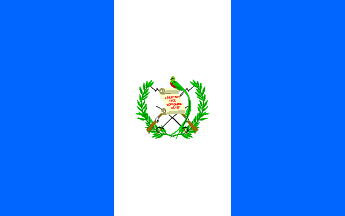
Guatemalan Flag