In conclusion, I enjoyed my stay in Latin America. I appreciated the hospitality of my hosts who allowed me to stay with them. The trip was more than I expected it to be, and I learned much about each country’s culture, and history. Lastly, I hope anyone who sees any of these beautiful countries, that they will enjoy them as much as I did.
Monday, February 3, 2014

Chile: Day 3
My last day in Chile was spent in Temuco. Temuco is a city with a population of about 270,000. Temuco is located near the western border of Chile south of Valparaiso. The city is currently the capital of La Araucania region in southern Chile. I spent my time in Temuco with a man named Jorge and his wife. Jorge’s occupation was working for the government. Their house was very simple. It was a one floor house with a kitchen, two bedrooms. Jorge was a worker in the Chilean service industry. On the way to work he explained to me that the service activities make up a good percentage of the economy. We arrived at his government office. I was told it was common for Chileans to work in the government. My friend’s job was to organize and arrange fund raisers and gatherings. My job was to deliver files and messages to the other workers. At midday there was a short fifteen minute break. At the end of the day, I was exhausted from moving from one level to the other, but I was glad to have helped. At home Jorge’s wife had prepared dinner. We had a beef stew served with rice, in a warm broth.
 |
| Temuco |
Chile: Day 2
The second day was spent in the coastal city of Valparaiso. The most recent recorded population of the city is 253,500. The city is an important port to Chile. It is important because it exports and imports cotton goods, liquor, machinery, refined sugar, and tobacco. I spent my time in a small three roomed house with a fisherman, Gustavo and his young adult son, Camillo. In the morning, we rented fishing poles and bought bait. On our way, Camillo told me about the folk tale of the chupacabra, a mysterious creature that sucked the blood of farm animals. Locals called it the “goat sucker”. He also told stories of how some of his neighbors saw the chupacabra, but the father said that he was lying. Once we got to the dock we paddled a few hundred feet offshore and fished. At the end of the day, we were rewarded for our hard work. We had a total of twenty-six fish. The day had been long, sitting on the boat for hours in the sun. Then we went into town and traded our fish for supplies and money. At home, Camillo and Gustavo had started preparing dinner. The meal was Cazuela de Ave, which is a soup with pieces of meat, potatoes, and noodles.
 |
| Cazuela de Ave |
Chile: Day 1
The first city I visited was Santiago. The city has a population of 6 million. I spent my time in Santiago in a small one level house with a farmer, Pablo and his wife, Andrea. I woke up in the morning at 4:00 a.m. to walk to work with Pablo. We walked through cobble streets through the relatively flat terrain, and on the way, Pablo explained to me that most people were mestizos (people of European and native descent). On the way to work, I noticed the many Catholic churches. Pablo told me that most people he knew were Catholic, again due to Spanish influence in this country. We labored all day long, and at the end of the day we were paid and allowed to take home a few leftover ginger seeds. We then went downtown to buy a fish, which we cooked when we returned home. We divided the fish in thirds for dinner. Then we planted the seeds in the backyard garden. At the end of the day, we traveled as a group to go to church. The meaning for the celebration was the Assumption of Mary, which is a religious holiday. After mass we walked back home to sleep. Lastly, we planted the seeds in the backyard garden.
 |
| Santiago |
Introduction to Chile
The third country I visited was Chile. Chile is a country known for its long skinny shape. The present-day capital of Chile is Santiago. Chile was originally a Spanish colony in the 1500s to the early 1800s. The climate depends on the region you are in, yet overall the country is not terribly warm. The country is composed of three main regions: the Northern Desert, the Central Valley, and the Southern Archipelago. The Northern Desert contains Chile’s main exports of copper and sodium nitrate. The Central Valley contains rivers that runoff from the Andes and produce the most fertile soil. Lastly, the Southern Archipelago is composed of rocky islands and is scarcely populated with sheep farmers. The government of Chile is a republic, and the national language is Spanish. The currency is the Chilean peso, and the country’s main export is copper. Chile’s population is 17.5 million, and the main religion is Roman Catholic.
 |
| Chilean Flag |
Jamaica: Day 3
The last day in Jamaica was spent in Portmore. I spent that time with a local man, Winston, who was manager at a local fast food restaurant. Portmore is a suburb of Kingston and has a population 98,000. In the morning, Winston and I walked downtown. He told me that Portmore is more modern than other Jamaican cities, yet it still shares the same culture as the rest of the country. Secondly, he told me that in the city American fast-food restaurants and shopping centers are popular. He also said without the jobs the restaurants and stores provided, he didn’t know what he would do. Also he said that went for most of the people in Portmore. After day’s work, we headed home late to eat dinner. Then we went to the Portmore Festival that hosts concerts throughout the year. We paid the cheap fee and enjoyed Jamaican music. Most of the songs were songs made by Bob Marley, a famous Jamaican musician. Some people throw colorful beads and confetti from balconies and I was lucky enough to catch a beaded necklace. After the Portmore Festival we walked back home. My time in Jamaica was up. Overall, I felt the companionship and the friendliness of the Jamaican people.
 |
| Statue of Bob Marely |
Jamaica: Day 2
The second day was spent in Spanish Town. The city was established by St. Jago de la Vega in 1534. There I stayed with a family in a two roomed house made of wood and straw. The population of Spanish town is about 100,000, and is located in the St. Catherine Parish (similar to states). I was woken up early in the morning to go to work and did not have breakfast. On the way to work, the father, Fernando, filled me in on the brief history of Jamaica. I learned that Spanish Town was the original capital of Jamaica. Also while walking I saw a statue. Fernando told me it was a statue of Admiral Lord Rodney who was in the British navy. He defeated a Spanish and French invasion. When the capital became Kingston the statue moved with it. People who disapproved of the move, followed the statue and attempted to kidnap it. In the process a hand was lost, but the statue was soon returned to Spanish Town. We spent the day fishing on a small wooden boat, and at the end of the day we had caught a variety of fish. We sold the fish at the local markets for the highest price we could get. At the end of trading we came home with 5,342 Jamaican dollars ($50), a half cup of rice and a pound of beef. At home the Fernando’s wife made beef soup with rice. Later in the night we went to the Reggae Sumfest. The Reggae Sumfest is an annual music festival in which reggae artists play their tunes. The most famous reggae musician was Bob Marley.
 |
| Alfred Lord Rodney |
Jamaica: Day 1
The first day in Jamaica was spent in the capital, Kingston. The city has a population of 650,000 people, which makes it the largest Jamaican city. The population of Kingston accounts for about ⅓ of the Jamaican population. In Kingston I lived with a cheerful family who lived in a shack on stilts near the sea. On the way to work with the father I saw many street vendors selling hand-made crafts. Some products include hand-woven baskets and pots. My personal favorite was a life size wooden carving of Bob Marley. Next we crossed through the local public park, William Grant Park. It is nicknamed “parade”, because its busy walkways. The father told me that the park commemorates the national hero and former prime minister, William Grant who was a labor leader. He fought for better wages for Jamaicans. Once we walked out of the park I saw the contrast between the two parts of the city, an area of skyscrapers surrounded by rusty, wooden shacks. The husband told me that he gradually worked his way up in the ranks, and was now the manager at the local harbor. Jamaica’s harbor is known to be the 7th largest natural harbor in the world. Once we reached the dock we overlooked the traffic of the cargo boats. After work, we walked back home and had a simple meal of banana porridge.
 |
| Kingston Market |
Introduction to Jamaica
The second country I visited was Jamaica. Jamaica has one the best tourism industries in the Caribbean. The current capital of Jamaica is Kingston. Jamaica was first claimed by Christopher Columbus for Spain in 1494, and gained full independence in 1962. Jamaica’s climate is hot and humid. This climate makes it possible for Jamaica to grow its main exports of sugar cane, and bananas. Like Guatemala, the country is divided into three main regions: the central hills and plateau, coastal plains, and the eastern mountains. The national language of Jamaica is English, and the currency is the Jamaican Dollar. The government is a constitutional monarchy, and there is a prime minister. Lastly, the population of 2.7 million is prominently African.
 |
| Jamaican Flag |
Guatemala: Day 3
I spent my last day in Guatemala in Antigua on July 25, the feast day of St. James, in a two roomed apartment, this time by myself. Locals told me each city has a patron saint, who they celebrate on a certain day. Saint James is the patron of Antigua and his feast day is July 25. While I was in Antigua, the people celebrated with food, dancing, and unique clothing. One dish I particularly remember was the “roscos”, which is stale bread in the shape of a donut. Roscos are sold by street vendors during fiera (fiesta) time. Another dish was “Saq ik” which is turkey covered in white sauce. The dancing in the streets was a mix of Spanish, Moorish, African, and Iberian influence. At midday, there was a parade through the streets. Toritos (men wearing cages of fireworks) warded away evil spirits with the explosions of fireworks. The Toritos charged the crowds, while I was luckily on a balcony observing. Next came the cofradias (people elected to direct the procession) who carried images and other symbols of St. James through the streets. After the celebration I joined the dancing and listened to the beat of the national instrument, the marimba. The marimba is a percussion instrument similar to the xylophone. The marimba is typically played by six to eight men at one time, while accompanied by saxophones , trumpets, and banjos.
 |
| Torito |
Guatemala: Day 2
The second day in Guatemala was spent in Tikal. In Tikal I stayed with a local man, Paulo, who was kind enough to open up his house to me. Tikal is less populated than Guatemala City, but very interesting. The city is important to Guatemala, because it displays the traditional culture of Guatemala and its history. The area around Tikal is a jungle. This jungle provides a biodiverse population of organisms. I was fortunate enough to be able to journey through it on the way to Paulo’s work. On the way I saw various animals including: ocelots, jaguars, tapirs, and monkeys. Paulo taught me about mahogany, cedar, chicle and balsam trees. Chicle trees are currently used to make gum, and the mahogany, cedar and balsam trees are used for flooring and construction. Next, we talked about the Mayan temples and some of the ruins that even date back to 1000 B.C.. He said that Tikal was a major city during the early Mayan era, and the population was estimated to be about 40,000. Historians do not know for sure if Tikal was the Mayan capital. Another feature the city is known for its well preserved temples. Next we arrived at EL Peten, which is a massive banana plantation important to Guatemala’s economy. I spent most of the day working there and picking ripe bananas. The last few hours in Tikal was spent playing with native Guatemalans in a game of soccer, which is the country’s national sport. In the end, my team won 2-1 after a hard fought match.
 |
| Tikal Temple |
Guatemala: Day 1
The first day was spent in the capital, Guatemala City. There I stayed with a average local family, Luis the father, Maria the mother and two children, Jose and Juan. They provided housing and my meals. In the morning I walked through the streets and observed street vendors selling traditional colorful textiles. Then I went to work in the city with the Luis. While walking, I observed the traditional Spanish-styled buildings. The reason for the design is due to early Spanish colonization. As I spent time talking to Luis, I learned was that there are two main cultural groups: the Mayans and the Ladinos. The Mayans trace their ancestry back to the original natives of the land, the Mayans. The main language of the Mayan group is Spanish, yet the language of the Mayans is taught to the Mayan children by the Academy of Mayan Languages. The clothing of the Mayans include distinct names. One is a “corte” which is a long skirt worn by women. Another is a huipil which is a blouse. Men usually wear modernized clothing, but traditional articles include a “morral” which is a satchel-like object. Men also wear a “mecapal” which are widened belts used to carry heavy loads. The other cultural group is the Ladinos, which includes all non-Indian people. The Ladino culture is taught in school and the group influences much of the country. One example including the coat of arms which depicts a conquistador. Lastly, the religion of the country is Catholicism due to the Spanish colonists. After about a mile, walk we reached downtown where we most of the day sorting coffee beans in a factory. At home, Maria taught me how to weave a textile. By the time it was dark, I had a colorful tzute, which is a multi-purpose hand towel. Maria explained to me I could use it for carrying large loads or to shield myself from the sun.
 |
| Tzute |
 |
| Queztal |
Introduction to Guatemala
The first country in my Latin American journey starts in the lovely country of Guatemala. This country is home to the largest Central American population. It also contains the largest Central American city. The capital of Guatemala is presently, Guatemala City. The country started out as a Spanish colony that was conquered by Pedro de Alvarado in 1523. Guatemala did not gain full independence until 1823. Guatemala’s climate is tropical, which contributes to its thriving agricultural economy of bananas, sugar cane, and coffee beans. An important fact about Guatemala’s economy is that they produce more goods than they have imported to them. Guatemala is composed of three main regions: the Northern Plain, the Pacific Lowland, and the Highlands. The Northern Plain is mainly forest, the Pacific Lowland is occupied by farming and the Highlands are composed of high elevations and contain the most Guatemalans. The national language of Guatemala is Spanish, the currency is the quetzal, and the government is democratic. The population is a mix of ethnicities, and is currently at the number of 15.1 million.
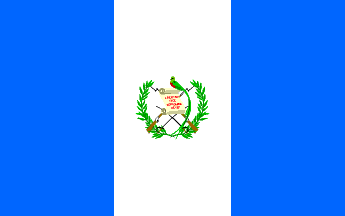 |
| Guatemalan Flag |
Subscribe to:
Posts (Atom)